
What happens in the brain during orgasm? A great deal, and not always the simple “switch-off” that headlines promise. Brain-imaging studies are small and technically difficult. Their different methods and findings are more interesting than a single magic-region story.
The Big Switch-Off?
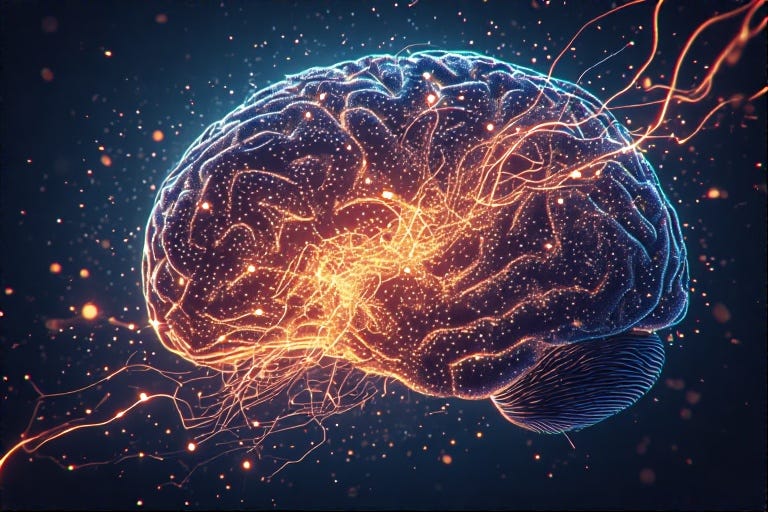
One imaging study reported reduced blood flow in the left lateral orbitofrontal cortex during clitorally induced orgasm and proposed that it might relate to behavioral disinhibition. But a later fMRI study found no evidence of brain-region deactivation leading up to or during orgasm; it reported activity in sensory, motor, reward, frontal, and brainstem areas, including the orbitofrontal cortex. Neither result proves that a part of your brain must “turn off” before you can climax.
For Amanda, the subjective story may be a moment when ordinary worries recede. For Peter, it may feel more like focused attention than surrender. Those are lived descriptions, not brain scans. Neither person has to reproduce a particular mental state to have a good experience.
A Neurochemical Symphony, With Caveats
Reward, sensation, movement, and emotion-related brain systems participate in sexual response. It is tempting to narrate this as a precise cocktail of dopamine, oxytocin, endorphins, and serotonin that inevitably creates pair-bonding and cures stress. Human studies do not support that tidy script for every person. Oxytocin findings, for example, vary with measurement and study design; a systematic review discusses those limitations.
Pleasure can be connecting, but a chemical explanation should not be used to predict how attached someone will feel afterward. Some people feel relaxed, some energized, some emotionally tender, and some unchanged.
Your Brain on Bliss Is Uniquely Yours
The neuroscience offers glimpses, not a performance manual. You do not need to “switch off,” surrender control, or chase a hormonal afterglow. Notice what the experience means to you, communicate when another person is involved, and let a complicated brain be complicated.
Sources
- . Regional cerebral blood flow changes associated with clitorally induced orgasm in healthy women. European Journal of Neuroscience, .
- Brain Activity Unique to Orgasm in Women: An fMRI Analysis. Journal of Sexual Medicine, .
- How Relevant is the Systemic Oxytocin Concentration for Human Sexual Behavior? A Systematic Review. Sexual Medicine, .

Member conversation
Comments
Comments are available to signed-in Voyeur members and above.
Sign in