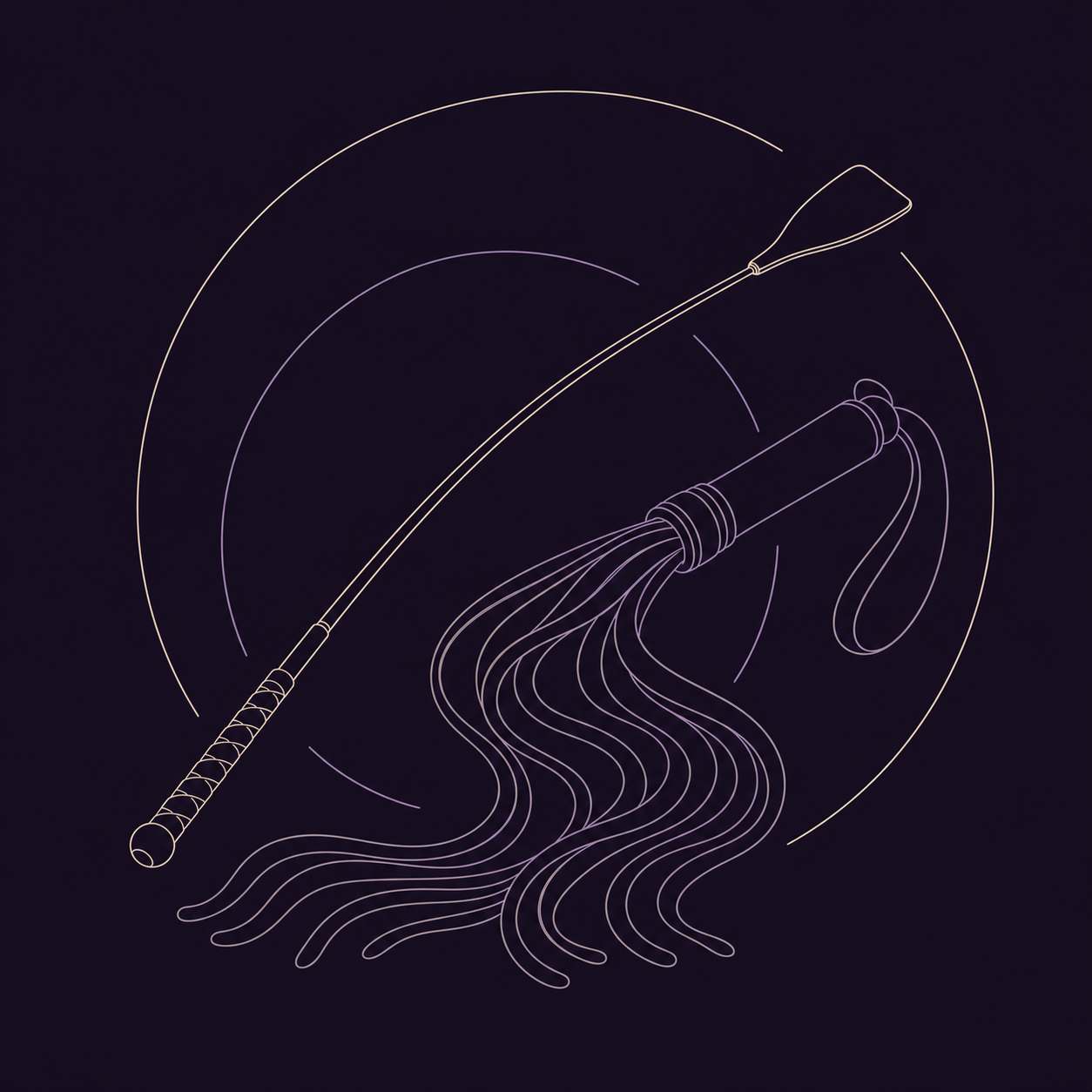
What is Whips?
A whip is a long-range impact implement used in BDSM scenes by consenting adults. Compared with other impact tools, whips demand more technique because the striking point can travel quickly and over a wider arc. That makes accuracy, distance, and environment especially important. Many people are drawn to whips for the snap of the sound, the visual intensity, or the dynamic of anticipation; others enjoy them as part of a more structured dominance/submission scene. Because they can cause significant injury when misused, whips sit firmly in the advanced-risk category.
What it is distinct from
Not the same as canes, paddles, floggers, or crop play. Whips tend to be longer-range, harder to aim precisely, and higher risk because small mistakes can cause deep injury. They are also distinct from any form of punishment, coercion, or non-consensual striking.
Common variations and contexts
- Single-tail whips used in advanced scenes
- Signal whips and performance-style whips
- Decorative or fantasy-only roleplay whips that are not used on the body
- Impact-play scenes where the whip is used sparingly among other lower-risk tools
Why people may explore it
Adults may explore whips for sensation, ritual, scene intensity, or the psychological effect of a controlled, precise strike. Some enjoy the trust, anticipation, and discipline involved; others are interested in the aesthetic or power-exchange symbolism rather than heavy impact.
Consent and communication
Use explicit, informed, prior consent from all participating adults. Negotiate exactly where, how hard, how many times, what type of whip, and what is off-limits. Discuss stop words or signals, vision/space issues, aftercare, and whether anyone wants to pause or end the scene at any time. Because whips are advanced and can escalate quickly, consent should be specific to the tool and the target areas, not just a general okay for impact play.
Words someone might use
"I’m interested in a whip scene, but only if we keep it light, avoid sensitive areas, and stop immediately if either of us wants to." "Please confirm where you’re okay being struck, what intensity you want, and what your stop signal is." "I’m only comfortable with adult consensual play, and I want to keep this limited to negotiated targets and agreed limits."
Safety and risk awareness
Whips are advanced-risk and can cause deep cuts, bruising, eye injury, nerve injury, or damage to vulnerable structures. They require substantial skill and are not a beginner implement. Keep well away from the head, face, neck, kidneys, joints, spine, genitals, and other highly vulnerable areas. Use clear space, good lighting, and full attention; avoid alcohol or drugs. If a person is not fully informed, not consenting, or not an adult, do not use a whip. If you are looking for gentler sensation or are unsure, choose lower-risk impact tools instead.
Aftercare and follow-up
Aftercare may include a calm check-in, water, rest, and assessment for skin injury or delayed pain. Watch for swelling, dizziness, numbness, vision changes, or any wound that seems deeper than a surface mark; seek medical attention if symptoms are concerning. Emotional aftercare can matter too, especially if the scene involved intensity, vulnerability, or power exchange.
Common misconceptions or contested usage
A common misconception is that a whip is just a more dramatic paddle or flogger; in reality, it is usually much harder to control and therefore much riskier. Another misconception is that a scene is safe if it feels exciting or if a person has previously agreed to impact play in general. Whip play still needs fresh, explicit consent for the specific implement and scene. Some people use the term loosely in fantasy or costume contexts; that is distinct from actual body impact and may be a safer way to enjoy the theme without physical risk.
Sources and further reading
- Planned Parenthood: Sexual Consent — Clear, accessible overview of affirmative consent and why it must be freely given, informed, and reversible.
- NCSF Consent Counts — Kink-specific consent resource emphasizing explicit prior permission and practical negotiation norms.
- Scarleteen Sex Readiness Checklist — Helpful for assessing readiness, communication, boundaries, and the ability to say yes, no, or maybe.
- ACA Kink Culture — Professional overview of kink as negotiated, consensual activity and the importance of ongoing consent.
Editorial note: This entry was prepared and maintained by the Orgasmaphoria editorial team. It is educational, applies only to consenting adults, and is not an instruction manual or medical guidance. No specialist credential is claimed unless a named qualified reviewer is explicitly shown.
Last reviewed July 28, 2026
Report a correction or source concern